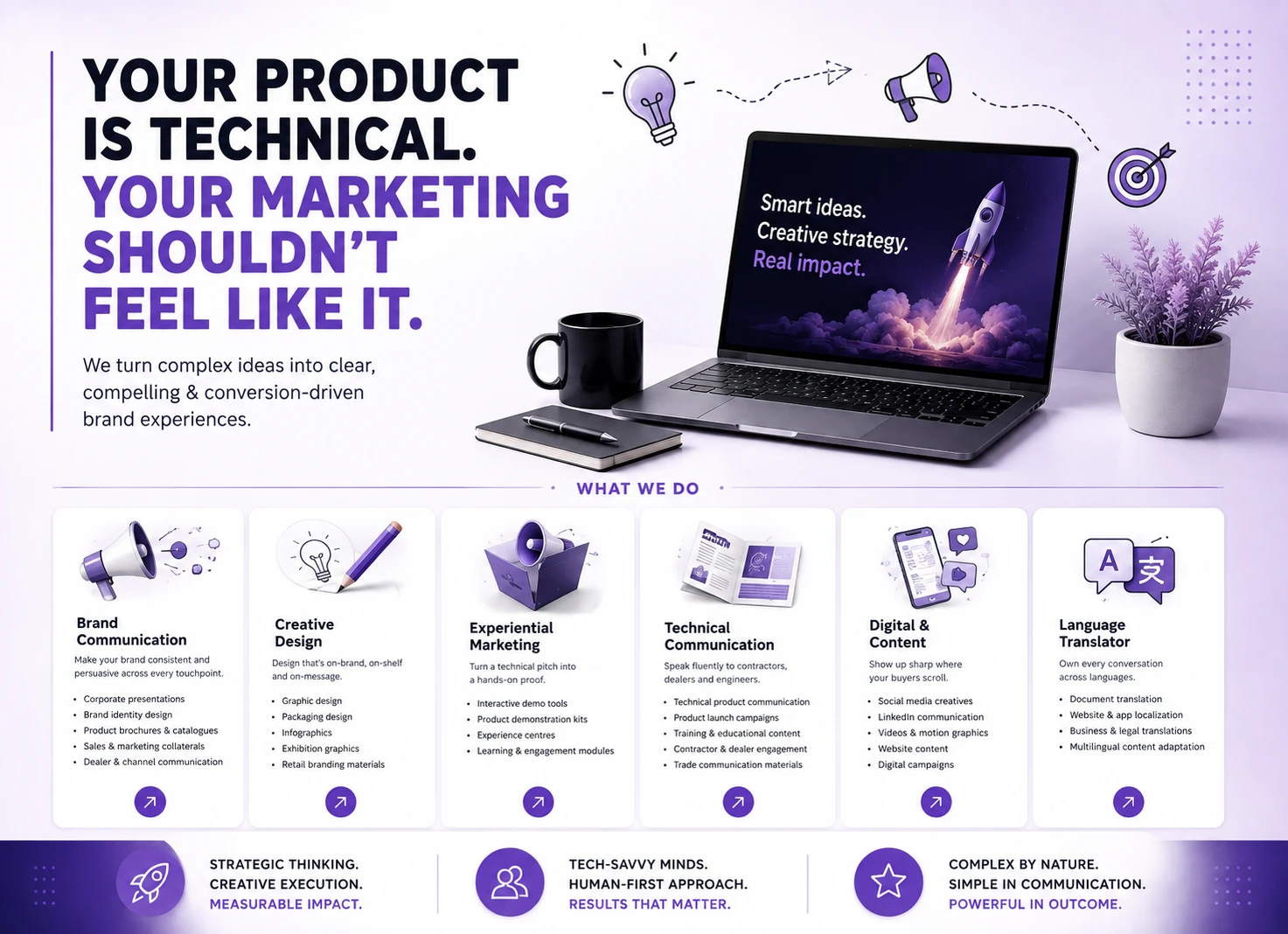
Your Product Is Technical. Your Marketing Shouldn’t Feel Like It.
There is a particular kind of brochure that almost everyone in a technical industry has seen.Dense columns of specifications. Pages of test standards. Tables filled with mechanical properties. Cutaway diagrams that make perfect sense to an R&D team — but mean very little to anyone else.The information is accurate. It is comprehensive. It is technically sound.And yet, on a job site, in a dealer’s hands, or on a specifier’s desk, it often does very little to move a decision forward.The problem is not the product.The problem is the gap between how a product is engineered and how it is chosen.Close that gap, and technical communication stops being a documentation exercise and becomes a powerful sales tool.
Two Readers. One Page. Two Very Different Needs
Technical collateral often makes the same mistake: trying to communicate with everyone at once.But different audiences make decisions in different ways.A specifier — an architect, contractor, applicator, procurement engineer, or technical consultant — wants evidence. They need test standards, coverage rates, chemical resistance, application data, warranty information, dimensions, and other measurable details. Give them vague marketing language, and credibility disappears.A buyer or influencer — such as a homeowner, builder, business owner, or decision-maker — starts somewhere else.They want to understand:
Why should I care?
What does this product do for me?
Why should I choose it over the alternatives?
Trying to answer both audiences with the same page usually creates a communication problem. The technical reader does not get enough information, while the non-technical reader gets overwhelmed.That is why audience definition should come before content creation.When we developed two catalogues for Essess bath fittings, we approached the two audiences as completely different communication challenges.The B2B Plumber Guide was designed as a practical spares-and-parts reference. Exploded views, part codes, dimensions, and technical information were organised so that a technician could quickly identify the right component.The B2C catalogue had a completely different role. It focused on finishes, form, design, and aspiration — helping a homeowner imagine the product in their own space and, ultimately, want it.The brand remained consistent.The communication did not.That leads to the first principle:
Decide who the page is for before deciding what goes on it.
Density Isn’t the Enemy. Disorganised Density Is.
There is another common mistake in technical marketing: assuming that simplifying communication means removing technical information.It doesn’t.Specifier audiences often want detail. Specifications, performance data, standards, and technical properties are what allow them to evaluate risk and make informed decisions.The real problem is not information density.It is poor information architecture.Consider Asian Paints’ Apcoflor floor-coating range. The product system involves composite layers, mechanical properties, chemical resistance, and different applications across industries.Removing the technical information would have made the communication weaker.Instead, the information needs to be structured.System diagrams can show how different layers work together. Industry-based navigation can help a reader quickly find applications relevant to sectors such as pharmaceutical or automotive. Property tables can be formatted for scanning rather than reading line by line.The result is still information-rich — but it becomes easier to navigate.And that distinction matters.A technical document should not force a busy reader to read everything.It should help them find exactly what they need.
The Ten-Second Test
Ask yourself: Can the intended reader find the one fact they came looking for in under ten seconds? If the answer is yes, your information density is probably working.If the answer is no, adding more design elements may not solve the problem. The information itself needs better organisation.
Show the Mechanism. Don’t Just Claim the Benefit.
Technical industries are full of familiar phrases:
“Superior adhesion.”
“Advanced technology.”
“Long-lasting protection.”
“High-performance solution.”
“Superior durability.”
The problem is not that these statements are necessarily wrong.The problem is that everyone says them.When every competitor uses similar adjectives, language alone becomes a poor differentiator.This is where visual communication becomes particularly powerful.Instead of simply saying that a coating has superior adhesion, show why it bonds.Instead of claiming that a waterproofing membrane provides crack-bridging capability, show how the membrane responds when the underlying surface moves.Instead of describing a complex manufacturing or application process in three paragraphs, visualise the process.A cutaway illustration, 3D render, technical animation, or process visualisation can communicate something that several paragraphs of copy often cannot:
The mechanism behind the benefit.
And when the mechanism is visible, the claim becomes easier to understand — and easier to believe.That credibility matters commercially.A believable benefit is easier to justify.And a justifiable benefit creates a stronger case for the product’s value and price.This is why 3D visualisation and motion have become increasingly important in technical communication.They are not simply decorative elements.Used correctly, they are tools for making invisible advantages visible.
Technical Communication Should Help People Make Decisions
The best technical collateral does not simply provide information.It reduces the effort required to make a decision.A specifier should be able to quickly answer:
Does this product meet my requirement?
What are its performance characteristics?
Where can it be used?
How is it applied?
What standards does it meet?
What evidence supports the claims?
A buyer should be able to answer:
What problem does this solve?
Why is it better?
What will the result look or feel like?
Why should I trust it?
What should I do next?
The communication may look different for each audience, but the underlying objective is the same:
Make the decision easier.
A Practical Checklist Before Your Next Technical Communication Goes to Print
Before signing off on your next brochure, catalogue, product launch kit, presentation, or technical sales asset, ask five simple questions.
1. Is There One Primary Reader?
If you cannot clearly identify who the communication is intended for, the content is probably trying to do too much.Define the audience first.
2. Does It Pass the Ten-Second Test?
Can the reader quickly locate the specification, benefit, application, or proof point they need?If not, rethink the structure.
3. Are You Using Proof Instead of Adjectives?
Important claims should be supported by something tangible:
A test standard
A performance figure
A certification
A technical comparison
A diagram
A demonstration
A relevant visual
Proof builds confidence. Adjectives rarely do.
4. Have You Made the Mechanism Visible?
Find at least one place where the communication shows why the product works, rather than simply saying that it works.
5. Is the Next Step Clear?
Once the reader understands the product, what should they do?
Specify it.
Request a sample.
Speak to a representative.
Ask for a quotation.
Visit the website.
Start a conversation.
Good communication should not leave the reader wondering what happens next.
The Real Business Value of Better Technical Communication
When technical communication is done well, it can accomplish something a conventional specification sheet rarely can.It can help a salesperson walk into a meeting already halfway to “yes.”The brochure has already explained the product.The catalogue has already organised the information.The visual has already demonstrated the mechanism.The animation has already made the complex process easier to understand.The salesperson is no longer starting from zero.They can focus on the conversation, the application, the customer’s requirements, and ultimately, the decision.That is the difference between collateral that sits in a drawer and collateral that supports a sale.For a brand with a genuinely better product, the right communication can be the difference between being the best-engineered option and being the chosen option.
Your Product May Be Complex. Your Communication Doesn’t Have to Be.
Technical products deserve technical accuracy.But technical accuracy does not require technical communication to be difficult to understand.The strongest technical marketing respects the complexity of the product while making the decision-making process simpler for the audience.It knows when to provide detail.It knows when to simplify.It knows when to show instead of tell.And, most importantly, it knows who it is speaking to.At Falcon Creatives, we have spent 17 years turning complex and technical products into communication that people can understand, remember, and act on — across paints, coatings, pharma, building materials, industrial products, and more.If your product is difficult to explain, that is exactly the kind of communication challenge we like solving.
Start a Conversation
Tell us what you are trying to communicate, who you need to reach, and where the current communication falls short. Let’s turn technical complexity into communication that sells. Start a Conversation