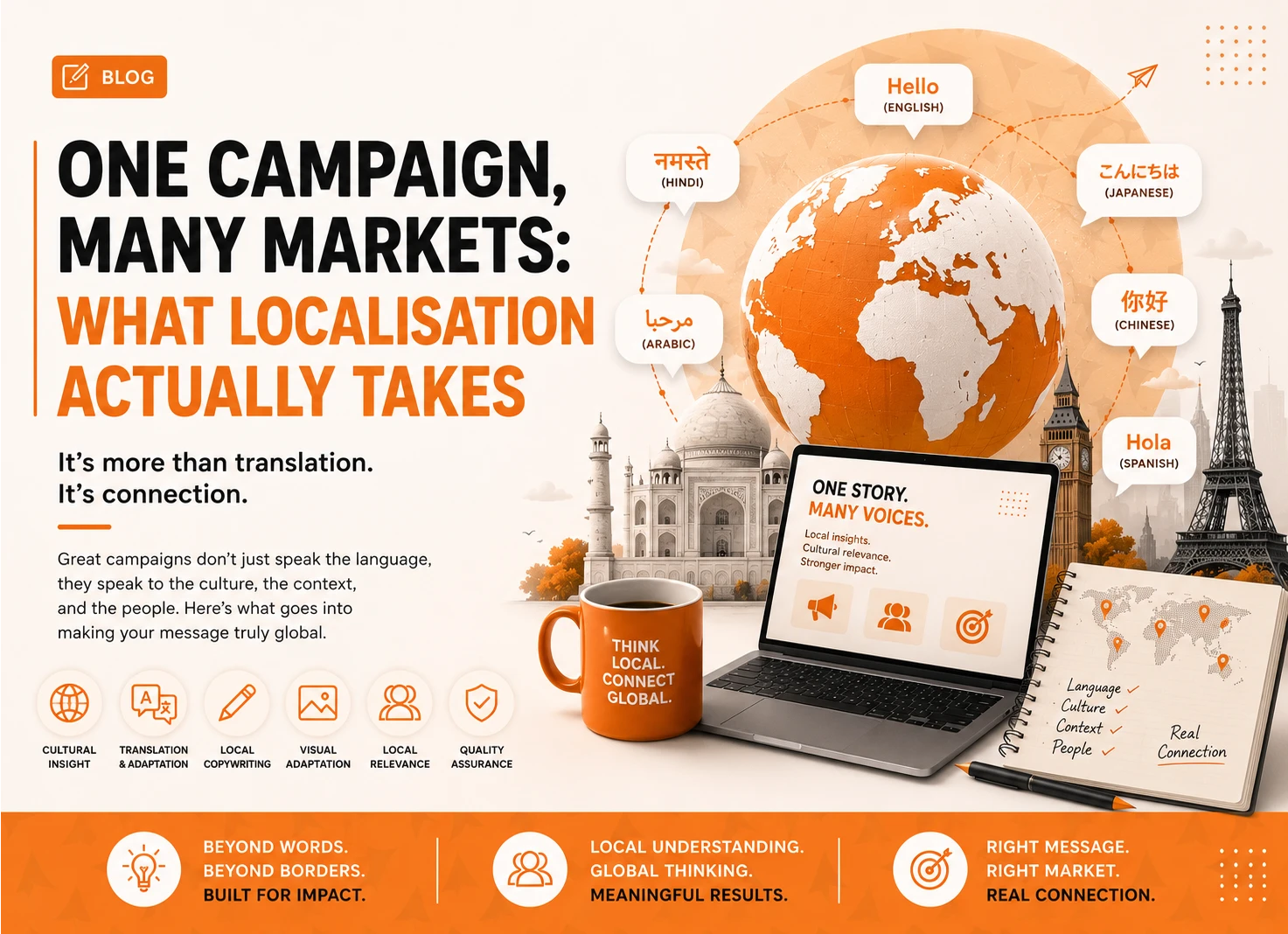
One Campaign, Many Markets: What Localisation Actually Takes
A brand creates a campaign it is proud of. It performs beautifully in the
home market. Then comes the next challenge: taking that campaign into
new regions and languages — perhaps Marathi, Assamese, or Bangla in
India, or Bahasa and Arabic in international markets.And then someone says the seemingly simple words:
“Let’s just get it translated.”That is often where the problems begin.Not because translation is unimportant, but because translation is only
one small part of what successful market adaptation actually requires.A campaign that works in one market cannot always be transferred directly
into another. The language may change, but so can the cultural context,
visual communication, typography, layout, tone, and even the way the
audience interprets the message.
Translation, Localisation, and Transcreation: Three Different Jobs
These terms are often used interchangeably. They shouldn’t be.
Translation
Translation converts written content from one language into another.
It is an essential part of entering a new market, but it is largely a
linguistic exercise.A headline can be completely accurate in another language and still feel
unnatural, uninspiring, or disconnected from the audience.
Localisation
Localisation goes much further.It adapts the communication to the market itself — including tone,
examples, imagery, units of measurement, cultural context, typography,
layouts, and the way content is presented.Even something as simple as text length can create a design challenge.
A short English headline may become significantly longer in another
language, changing line breaks, spacing, button sizes, and the overall
visual balance of a page.
Transcreation
Transcreation takes a different approach.Instead of translating the words, it recreates the
idea, emotion, and impact behind the original message
for a new audience.Puns, idioms, cultural references, humour, and wordplay rarely survive
direct translation. Transcreation replaces them with language and ideas
that create a comparable response in the target market.The words may be completely different.
The strategic idea remains the same.
Translation changes the language. Localisation adapts the experience.
Transcreation recreates the impact.
Many B2B brands budget for translation when what they actually need is a
combination of all three.
Design Is Half the Localisation Problem
One of the most underestimated aspects of localisation is what happens
to the design.Language doesn’t just change the words on a page.It changes the shape of the layout.Arabic, for example, reads from right to left. This can require layouts,
navigation systems, visual hierarchies, and entire spreads to be
reconsidered or mirrored.Devanagari, Bengali, and other Indian scripts have their own typographic
characteristics, including different line heights, spacing requirements,
and font considerations.Even languages written in the same direction can create significant
layout changes because translated copy may expand or contract.A button that comfortably accommodates
“Learn More” in English may suddenly become too small in another
language.A carefully balanced headline can become three lines instead of one.A product grid can lose its visual rhythm.And suddenly, what looked like a simple translation project becomes a
redesign exercise.When we built a bilingual product catalogue for
Asian Paints Berger in the Middle East, English and
Arabic had to coexist within a single publication.Feature grids, product callouts, technical information, and the
About Us data spread all had to work equally well in
both languages.Neither language could feel like the secondary version.That level of consistency is possible only when multilingual
communication is considered at the beginning of the design process —
not added after the English version has already been finalised.
Localisation is a design discipline as much as it is a linguistic one.
The two need to be planned together.
Regional India Is Its Own Kind of Global
It is easy to think of localisation as an international challenge.In India, it is often a domestic one.A single national campaign may need to work across dramatically different
linguistic and cultural environments.For Asian Paints’ Beautiful Homes, campaign communication
needed to work across formats and markets — from an outdoor hoarding in
Jalandhar to a Marathi newspaper page, a launch advertisement in
Bengaluru, and an Assamese regional insert.The language and contextual adaptations changed from market to market.The core brand idea did not.And that balance is the real challenge:
Local relevance without brand drift.
Make the communication too rigid, and it feels like a campaign imported
from somewhere else.Make it too loose, and you end up with multiple campaigns that no longer
feel like part of the same brand.Effective localisation sits between those two extremes.It allows the communication to feel genuinely local while maintaining a
recognisable and consistent brand identity.
What Good Localisation Actually Requires
If you’re taking a brand into new languages or markets, localisation
should be treated as a strategic process — not simply a translation
request.
1. Native Speakers, Not Just Fluent Speakers
Fluency is not always enough.Idioms, cultural references, tone, humour, terminology, and subtle
language choices require people who understand how the language is
actually used by its audience.A message should sound like it was created in the language, not translated
into it.
2. A Master Template Built to Flex
Multilingual design should anticipate change.Templates need to accommodate text expansion, different scripts,
alternative font requirements, reading directions, and changes in
hierarchy.Designing for localisation from the beginning is considerably more
efficient than rebuilding layouts after translation.
3. A Clear Glossary for Technical Terms
Technical and B2B communication requires an additional layer of
discipline.Product names, specifications, technical terminology, application terms,
and industry language need to remain consistent across every market.A poorly translated technical term can undermine credibility — and in
some cases, create genuine confusion about how a product should be used.
4. Local Review Before Launch
A translation can be grammatically correct and still sound wrong.That is why a second native-language review is valuable before anything
goes live or goes to print.The question is not simply:
“Is this correct?”It is:
“Does this sound right to someone who lives in this market?”
5. One Custodian of the Core Idea
Every market should have room to adapt the communication.But someone also needs to protect the central brand idea.A single strategic custodian can ensure that every language and market
version continues to connect back to the same campaign thought, brand
positioning, and business objective.Localisation should create multiple expressions of one idea — not
multiple unrelated ideas.
Why It’s Worth the Extra Effort
A market can tell when something was made for it versus
something that was simply sent to it.That distinction matters.Localisation done properly earns trust before you have even explained
the product.The audience recognises that the brand understands its language, context,
culture, and expectations.It creates the feeling that the brand has made an effort to communicate
with the market rather than simply communicate
at it.Poor localisation does exactly the opposite.Awkward language, incorrect terminology, broken layouts, unsuitable
imagery, or culturally inappropriate references can quickly communicate
one thing:
The brand didn’t care enough to get it right.
For brands operating across India’s many languages — and across global
markets — that is not a minor detail.It can be one of the very first impressions your brand makes.And first impressions are difficult to get twice.
Localise the Language. Preserve the Idea.
Taking a campaign into a new market is not simply a matter of replacing
one set of words with another.Successful localisation requires language expertise, cultural
understanding, design flexibility, technical accuracy, and strategic
consistency.The objective is not to make every market version identical.The objective is to make every version feel
native to its audience while remaining unmistakably
part of the same brand.At Falcon Creatives, we translate and localise brand
communication across Indian regional and global languages — from
Bangla, Nepali, and Bahasa to Arabic — while keeping
the design intact and the core idea consistent.Because when your brand enters a new market, the goal isn’t simply to
speak the language.
The goal is to make the audience feel that the brand belongs there.
Taking Your Brand Somewhere New?
Tell us which markets and languages you’re planning to enter.
We’ll help you turn one strong campaign into communication that feels
natural, relevant, and consistent everywhere.
Tell Us the Languages